China Best LC Connector Transceiver Manufacturer? This question matters as data centers demand faster, denser, and more reliable optical links. An LC connector transceiver supports practical fiber deployment, especially where rack space and maintenance access remain limited. Its duplex LC interface fits familiar cabling systems and helps technicians complete replacements with less disruption.
Cisco’s Annual Internet Report forecast global IP traffic reaching 396 exabytes per month by 2022. It also projected 29.3 billion connected devices by that year. These figures show why optical connectivity requires disciplined manufacturing, not attractive specifications alone. LightCounting’s market research has also highlighted strong optical demand from cloud computing, artificial intelligence, and hyperscale data centers. Demand keeps changing.
A qualified Chinese manufacturer should provide traceable test records, stable component sourcing, and clear compatibility data. Key checks include insertion loss, return loss, operating temperature, transmission distance, wavelength accuracy, and interoperability with major switch platforms. Experience matters here. A reliable factory should show aging-test procedures, sample reports, production certifications, and responsive engineering support. Certifications alone are not enough.
No supplier is perfect. Some product pages overstate performance, while field conditions expose weaknesses. Buyers should request samples, inspect connector polish, and verify performance under heat and vibration. The best LC connector transceiver manufacturer is not simply the lowest-cost supplier. It is the partner that combines repeatable quality, transparent evidence, and practical technical support. This article examines China’s leading candidates through those measurable criteria, while recognizing that product fit depends on network design, budget, and deployment conditions.
What Is an LC Connector Transceiver?
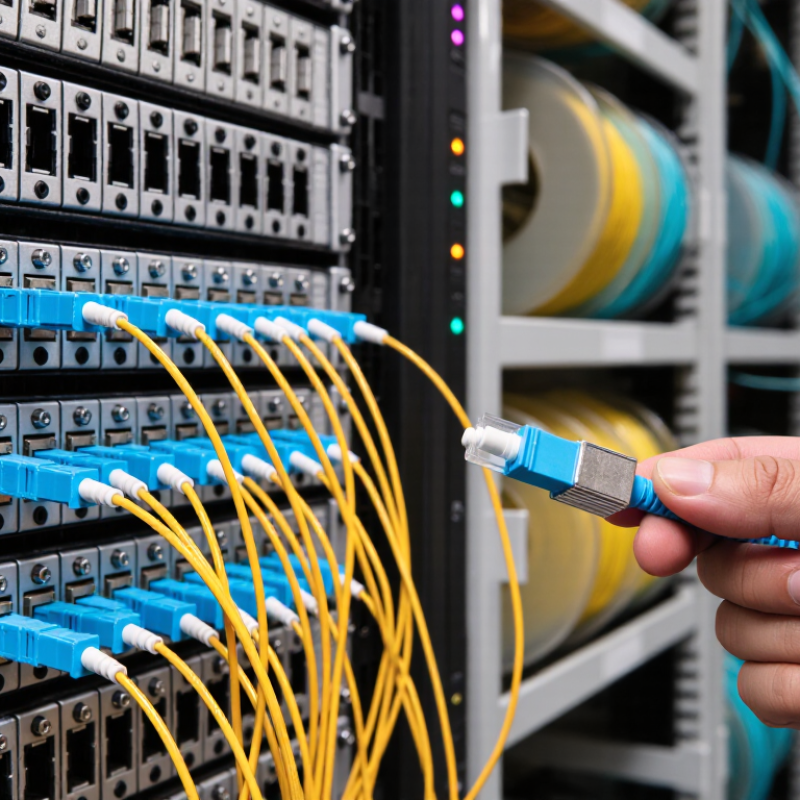
An LC connector transceiver is a compact optical module used to transmit and receive data through fiber. It combines an electrical interface with a small LC fiber connector. The LC connector uses a push-pull latch and a 1.25 mm ferrule. This design saves rack space and supports reliable connections in dense network equipment.
Inside the transceiver, a laser sends optical signals through the fiber. A receiver converts incoming light back into electrical data. Common versions support single-mode or multimode fiber. They may also operate at different wavelengths, data rates, and transmission distances. Engineers should check connector type, fiber mode, wavelength, reach, and device compatibility before installation. A matching label is not enough. The host device must also support the module’s electrical and optical specifications.
Cleanliness matters greatly. Dust on the LC end face can increase loss or cause unstable links. Technicians should inspect and clean connectors with approved tools before testing. In field work, I have seen a perfect-looking module fail because the patch cord was poorly seated. That mistake is easy to miss. Another concern is temperature. High-density cabinets can become warm, so operating limits deserve careful attention. Some selections still involve compromise: longer reach may increase cost, while tighter budgets can limit future upgrades. Testing insertion loss and link performance remains important, even when the connection appears normal.
| Dimension | Typical Details | Selection Considerations |
|---|---|---|
| What it is | An optical transceiver is a pluggable module that converts electrical signals to optical signals and back. “LC” refers to the small-form-factor connector interface used by many fiber-optic modules. | Check the module’s optical interface as well as its data rate and host compatibility; LC describes the connector, not the module’s speed or reach. |
| Connector configuration | Duplex LC uses two fiber paths, typically one for transmit and one for receive. Simplex LC BiDi modules use one fiber and transmit and receive at different wavelengths. | For duplex links, connect the transmit path at one end to the receive path at the other. BiDi links generally require a matched pair with complementary transmit and receive wavelengths. |
| Fiber type | Multimode fiber is commonly used with short-reach 850 nm optics. Single-mode fiber is commonly used with 1310 nm or 1550 nm optics for longer links. | Match the transceiver to the installed fiber type. A connector that fits physically does not guarantee that the fiber and optics are suitable for the link. |
| Example: 1 Gb/s optics | 1000BASE-SX typically operates at 850 nm over multimode fiber. 1000BASE-LX typically operates at 1310 nm and is commonly used over single-mode fiber. | Reach depends on the optical standard, fiber category, and link conditions. Confirm the specific module and equipment specifications before deployment. |
| Example: 10 Gb/s optics | 10GBASE-SR commonly uses 850 nm multimode optics; typical maximum distances include up to 300 m on OM3 and 400 m on OM4. 10GBASE-LR commonly uses 1310 nm single-mode optics for links up to 10 km. | These are standard-specific reference distances, not a guarantee for every installation. Check the optical budget, fiber grade, and applicable equipment documentation. |
| Wavelength and reach | Common wavelengths include 850 nm for many multimode short-reach links and 1310 nm or 1550 nm for many single-mode applications. | Compare wavelength, transmit power, receiver sensitivity, and maximum supported distance at both ends of the link. |
| Module form factor | LC interfaces are common on SFP and SFP+ modules. Higher-density form factors may use other connector types, although some variants or breakout arrangements can provide LC connectivity. | Verify the equipment port supports the module’s form factor, data rate, power requirements, and optical standard. |
| Connector polish and inspection | LC connectors are commonly available with UPC or APC polish. UPC and APC end faces are different types and should not be mated together. | Use matching connector polish, inspect and clean end faces before connection, and follow approved fiber-cleaning procedures. |
| Equipment compatibility | Compatibility can depend on the switch or router model, supported standards, module coding, firmware, and port configuration. | Confirm compatibility with the host equipment documentation and check whether the required speed and optical standard are supported. |
| Manufacturer evaluation criteria | Useful criteria include published specifications, compatibility information, quality-control documentation, warranty terms, technical support, and product traceability. | Compare documented performance and service terms against the network requirements rather than relying on connector type alone. |
Review datasheets, test records, and factory capabilities. Ask for clear figures on optical power, receiver sensitivity, wavelength tolerance, and operating temperature. Vague answers need follow-up.
Request samples from the same production line as regular orders. Test transmission distance, insertion loss, temperature stability, and connector fit with your equipment. Small defects matter.
Check insertion loss, return loss, receiver sensitivity, and transmitter output power. Match wavelength, fiber type, data rate, and distance to your network.
Inspect the housing, latch, dimensions, and end face. Dust is stubborn. Check that labels are accurate and packaging protects the connector during delivery.
Test at realistic operating temperatures and inspect diagnostic readings for temperature, voltage, and optical changes. Repeated insertion and removal can reveal issues that one lab test may miss.
Ask technical staff about coding, firmware options, and supported equipment. Try the transceiver in your own network. A datasheet alone cannot confirm every setup.
Request traceable calibration and final-inspection records, plus aging or temperature-cycle results. Confirm warranty terms, replacement handling, and lead times in writing.
No. Verify certification scope and validity, and consider a reasonable audit or network trial. I once trusted a good sample too quickly; later batches needed closer inspection.
An LC connector transceiver is a compact optical module that uses a small-form-factor LC interface to transmit and receive data over fiber. In a fiber network, it converts electrical signals into optical signals for transmission and converts incoming light back into electrical signals. Choosing the right module involves checking its data rate, wavelength, transmission distance, fiber type, connector configuration, and compatibility with the intended equipment. Relevant industry standards and specifications help ensure reliable operation and interoperability.
When evaluating Chinese LC transceiver manufacturers, consider product documentation, testing procedures, manufacturing consistency, technical support, and the ability to meet project requirements. Applications range from data centers and enterprise networks to telecommunications infrastructure. Quality factors such as stable optical performance, dependable connections, thermal management, and appropriate environmental ratings can affect network reliability and service life. A careful comparison of specifications and supplier capabilities helps buyers select an LC connector transceiver suited to their network needs.

 LumoWave